May 14, 2026
Why Your Crypto Tax Reports Don’t Match and What to Do About It
In this article, we will go over why wonky data makes crypto reports unreliable, what you can do to avoid problems, and how DACFO can help you. Read on!
Crypto Accounting
Crypto Bookkeeping
Crypto Tax
Digital Assets
Crypto is renowned for giving firms and individuals a great sense of control. In the early stages, everything appears manageable. There are only a handful of exchanges, perhaps a few wallets, a steady flow of transactions, and a piece of software that promises to tie it all together neatly. When the accounting reports come in, everything looks reasonable, and there is little to no reason for friction.
However, there is a point that most of them reach where this initial sense begins to slip. Suddenly, balances are slightly off in one report compared to another. Gains appear higher or suspiciously low, and summaries are hard to match up. What initially seemed like a minor discrepancy quickly turns into a more fundamental question: which version of the truth is actually correct?
While it is easy to believe that the software is to blame, the issue is usually something much simpler: the data it works with.
In this article, we will go over why wonky data makes crypto reports unreliable, what you can do to avoid problems, and how DACFO can help you. Read on!
The Breaking Point
What many people don’t understand is that crypto does not exist in a single, clear ledger designed for accounting purposes. In reality, it is scattered across a fragmented collection of systems that were never built to speak the same language. These systems can include:
- exchanges
- wallets
- DeFi protocols
- staking platforms
- bridges and smart contracts.
The issue is that each of them records transactions differently, so even something as simple as moving assets from one wallet to another can be misread. That is, naturally, where the first cracks in operations appear.
While the underlying blockchain data is highly structured and deterministic, it is not organized in a way that accounting systems can readily interpret without any additional context. That is how errors occur, and how reports start deferring too much for accountants and auditors to turn a blind eye to it.
Why Software Alone Isn’t the Answer
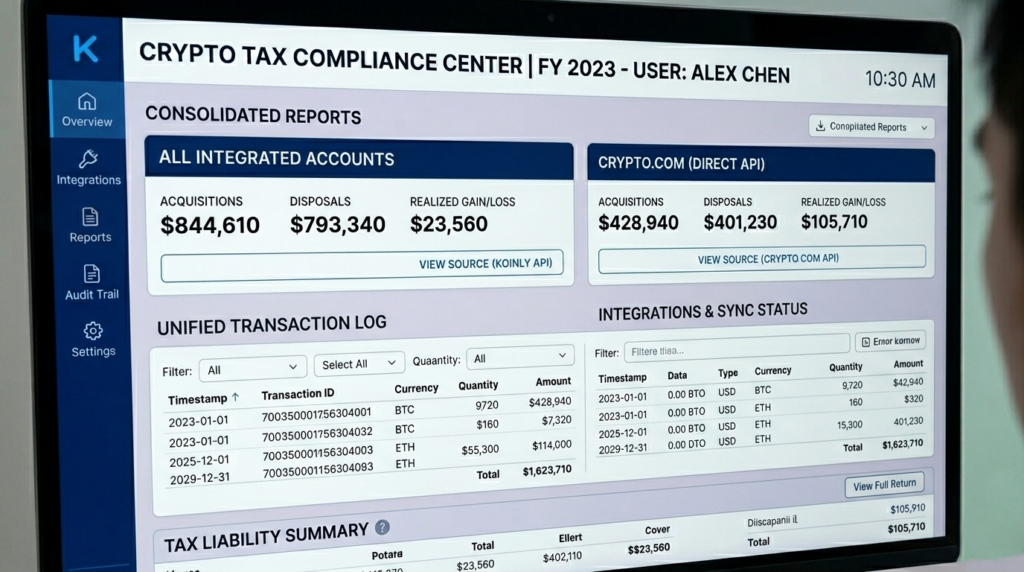
When discrepancies like these emerge, most business owners immediately start questioning the accounting tools they are using. Namely, they assume that switching to a different crypto tax platform will resolve the issues, as if accuracy were simply a function of better software.
In reality, most crypto tax tools operate in a similar way. They aggregate data from multiple sources, apply tax rules to it, and generate outputs based on said data. So, while they are highly effective at processing data, they are not meant to repair it.
For instance, if a wallet is missing or a transaction fails to import, the tool will simply proceed without the information about it. And if the information is incomplete or missing altogether, the resulting report cannot be reliable at all.
That is why different platforms can produce different results from what appears to be the same activity. After all, each tool is working with a slightly different version of the underlying data, and each is faithfully reflecting the gaps within it. Since the outputs come from imperfect inputs, they are equally imperfect.
The Real Issue: Cost Basis and Transaction Flow
Broken cost basis is at the heart of this mismatch, as usual.
Namely, cost basis is the foundation upon which all gain and loss calculations are built. When assets move across wallets, exchanges, and protocols, their history needs to move with them. If that chain of continuity is broken at any point, the downstream impact can be significant.
This breakdown typically occurs:
- When assets move between platforms without properly linking the outgoing and incoming transactions
- When original acquisition data is missing
- When historical records are incomplete.
Over time, gaps can accumulate, and what begins as a small inconsistency can easily evolve into a materially incorrect tax position.
Naturally, that is a big issue from a tax perspective. If cost basis isn’t calculated correctly, gains will likely be understated. That can, in turn, create exposure that may become extremely problematic later on.
With the introduction of new reporting frameworks such as Form 1099-DA, the importance of accurate cost basis tracking only increases. So, while brokers may report proceeds, they do not always provide complete cost basis information. That means the responsibility for maintaining accurate records ultimately remains with the taxpayer.
Classification Matters More Than Most Expect
Beyond cost basis, we also have to mention another layer of complexity in how transactions are classified. Namely, it is a fact that not all crypto activity is treated the same from a tax perspective. Yet in practice, distinctions are often grossly overlooked.
Generally, transactions fall into three categories:
- capital transactions such as buying, selling, or trading assets
- income events such as staking rewards, mining proceeds, or airdrops
- non-taxable transfers between wallets owned by the same entity.
While these categories might seem straightforward in theory, real-world data rarely arrives neatly labeled. As a result, misclassification is quite common. For instance, internal transfers get interpreted as taxable disposal, while staking rewards can be omitted entirely if the data source does not capture them.
While they might appear minor individually, these errors compound easily. Once multiple transactions are misclassified, the divergence between reports can grow rapidly, making reconciliation increasingly difficult and the final numbers unreliable.
What Reconciliation Really Entails
“When reports do not match, the solution is not to make a better version of the same output. True reconciliation begins at a much deeper level—with the reconstruction of the underlying data.”
The process starts by identifying every source of activity, including wallets, exchanges, and platforms that have been used. From there, the task is to rebuild full transaction histories, often by combining API data with manual exports and, where necessary, direct on-chain analysis.
Once the flow of transactions is re-established, cost basis is restored by connecting acquisitions to disposals in a consistent and defensible manner. Only then can a company review and classify transactions based on their actual economic substance rather than how they happen to appear in raw data.
For U.S. taxpayers, the final stage involves aligning this reconstructed dataset with formal reporting requirements, ensuring consistency between transaction-level disclosures (Form 8949), summary calculations (Schedule D), and any broker-reported information such as Form 1099-DA.
The objective is to produce numbers that tell a coherent story that can be traced, explained, and supported under any type of scrutiny.
The Hidden Risk of “Good Enough”

One of the more subtle risks in crypto reporting is the reliance on numbers that appear reasonable at first glance. When reports look broadly correct, it is very tempting to accept as such, especially when the alternative involves significant effort and complexity.
However, “good enough” reporting often masks underlying structural issues. Though the numbers may align internally, reconciling them with external data sources might be impossible.
Alternatively, they could hold for a single reporting period but break down completely once you revisit historical activity. As such, they often lack the transaction-level support required in the event of an audit.
As regulatory oversight continues to evolve, these gaps are becoming easier to detect. Discrepancies between self-reported data and third-party reporting are more visible than before, and the expectation of consistency is increasing accordingly.
What We See in Practice
Generally, most businesses do not address these issues proactively. Instead, they tend to surface when something feels off—when reports don’t align or when tax outcomes do not make sense.
By the time clients seek help, the problem reflects a broader pattern of fragmented data and a lack of structure that has developed over time. The longer this persists, the more complex the reconstruction becomes, as historical gaps need to be filled and assumptions need to be revisited.
How We Approach It at DACFO
At DACFO, we always start with understanding the data.
Our process begins with a comprehensive mapping of all activity sources, followed by the reconstruction of transaction histories across wallets and platforms. We trace cost basis from the point of acquisition through to eventual disposal, ensuring continuity at every stage. Then, we classify transactions based on their economic reality.
From this foundation, it is easy to build a consistent framework that aligns with current tax rules and reporting requirements while remaining flexible enough to accommodate future changes. The final result is a set of numbers that align with external reporting and hold up under review.
To Conclude
Crypto accounting is often described as inherently complex, but in many cases, the complexity arises long before accounting even begins. It is a consequence of fragmented, incomplete, and poorly structured data being forced into systems that expect clarity and consistency.
When the underlying data is unreliable, every output built on top of it will carry that uncertainty. But if you properly structure the data, much of the perceived complexity falls away, and the reporting process becomes significantly more straightforward.
Ultimately, this brings the conversation back to a more meaningful question. It is not about which software we use or which report looks more polished, but whether the data we use can be trusted.
If This Sounds Familiar
If your reports don’t match or if there is even a slight hesitation when relying on your numbers, it is worth addressing the issue sooner rather than later. Reconstructing crypto data after the fact is always more challenging than building a structured approach from the outset, and the cost of waiting tends to grow over time.
At DACFO, the focus is on helping businesses move from uncertainty to clarity by establishing structured data, producing accurate reporting, and ensuring that every figure can stand on its own under scrutiny. If that is what you need, contact us.
Let us help you make crypto accounting a breeze!
Read on the topic





Talk to an expert
Book a Consultation